


For anyone entering the world of currency exchange, timing is everything. The foreign exchange market is a decentralised global marketplace. Because it spans every time zone, trading occurs 24 hours a day during the work week. However, a common question for beginners remains: what time does the forex market open?
The global market officially begins its week at 5:00 PM EST on Sunday. It runs continuously until it closes at 5:00 PM EST on Friday. While the doors are always open, the market behaves differently at 3:00 AM than it does at 3:00 PM. Understanding these shifts is the difference between finding a steady trend and getting stuck in a stagnant market.
What Time Does Forex Start? Understanding the Weekly Kickoff
If you are looking to place your first trade of the week, you need to know what time forex starts in the global sense. The market cycle follows the sun. As one financial centre winds down, another begins its day.
The Sunday Launch
The trading week starts in New Zealand and Australia. At 5:00 PM EST (10:00 PM GMT) on Sunday, the Sydney session opens. This is the first opportunity for investors to trade based on news that occurred over the weekend.
However, the Sunday open is often “thin.” This means there are fewer participants. Because major banks in London and New York are still closed, price movements can be erratic. Many traders observe this period but wait for more volume before entering a position. If you are just starting, reading a broker review can help you find a platform with low spreads during these quieter hours.
The Five-Day Marathon
Once the market starts on Sunday, it does not stop. It moves through Asia, Europe, and North America in a seamless loop. The market only pauses when New York banks close on Friday evening.
When Does the Forex Market Open in Major Cities?
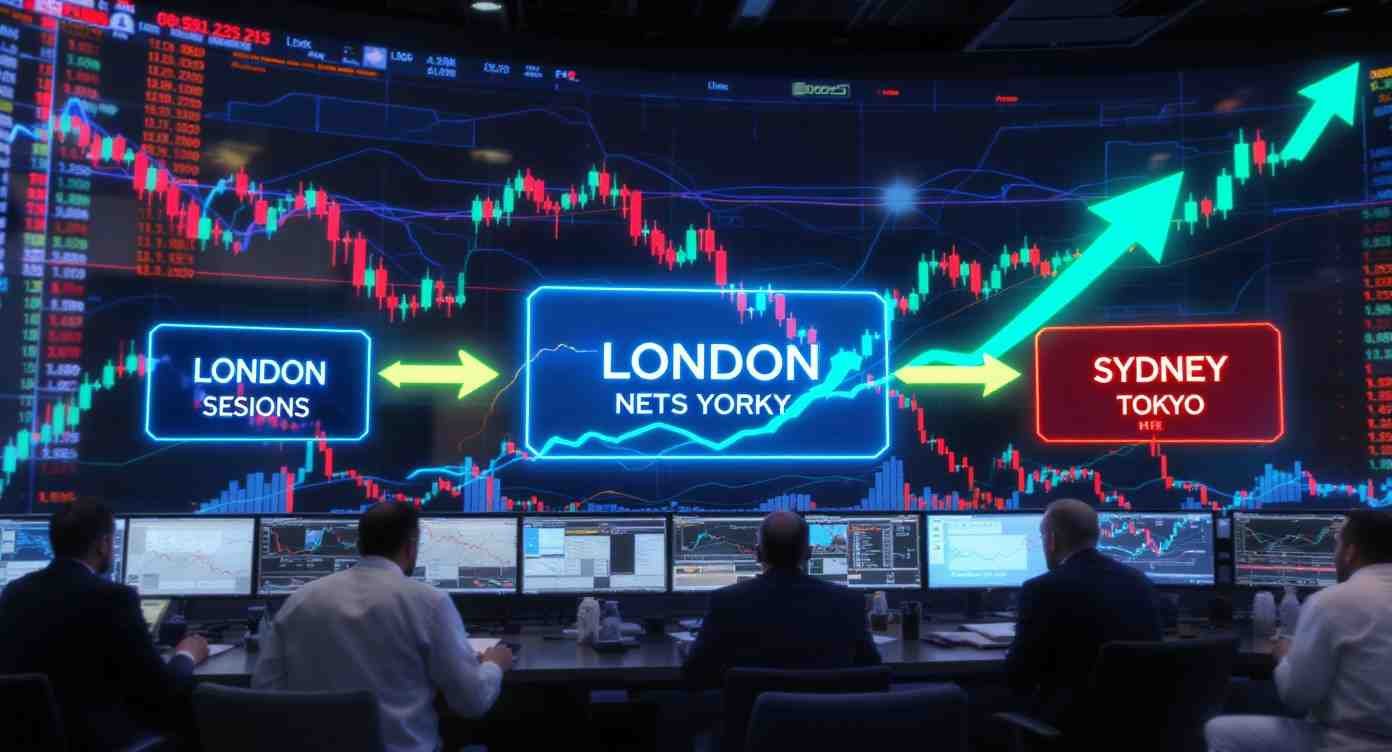
Each major financial hub has its own specific operating hours. To trade effectively, you must track when the forex market opens in these key locations.
The Asian Session (Tokyo)
The Tokyo session represents the bulk of Asian trading. It is known for being more disciplined and less volatile than Western sessions.
- Time: 7:00 PM – 4:00 AM EST
- Focus: This is the best time to trade the Japanese Yen (JPY).
The European Session (London)
London is the heart of global currency trading. More money changes hands here than anywhere else.
- Time: 3:00 AM – 12:00 PM EST
- Focus: Expect high volatility in the British Pound (GBP) and the Euro (EUR).
The North American Session (New York)
New York is the second-largest trading hub. Because the US Dollar is on one side of most trades, this session carries immense weight.
- Time: 8:00 AM – 5:00 PM EST
- Focus: Major pairs like the EUR/USD and USD/CAD see heavy action. Before trading these pairs, check our latest trading platform comparisons to find the lowest fees.
Strategic Overlaps: The Most Important Hours
Simply knowing what time the forex market opens is not enough. You must also identify when sessions overlap. An overlap occurs when two major markets are open simultaneously.
The “Power Hour” (London and New York)
The most critical overlap occurs between 8:00 AM and 12:00 PM EST. During these four hours, the world’s two largest financial centres are active.
- Liquidity: This period has the highest volume of buyers and sellers.
- Spreads: Because volume is high, transaction costs (spreads) are usually at their lowest.
- Opportunity: This is when the largest price trends usually develop.
The Transition (Tokyo and London)
Between 3:00 AM and 4:00 AM EST, Tokyo is closing while London is opening. This hour often sees a spike in activity as European traders react to the overnight news from Asia.
Why “Opening Times” Change: Daylight Saving Time
A point of confusion for many learners is how Daylight Saving Time (DST) impacts the schedule. While the local opening times in cities like London or New York remain the same (e.g., 8:00 AM local time), their relationship to your local clock might shift.
- Fixed Markets: Countries like Japan do not observe DST. Their session times never change.
- Shifting Markets: The US and UK change their clocks in March and October/November.
- The Result: If you live in a region that does not change clocks, the answer to “what time does the forex market open?” will shift by one hour twice a year.
What Time Does the Forex Market Open?
To help you visualise the 24-hour cycle, refer to this simplified schedule in Eastern Standard Time (EST):
| Market Session | Opening Time (EST) | Closing Time (EST) |
| Sydney Open | 5:00 PM (Sunday) | 2:00 AM |
| Tokyo Open | 7:00 PM | 4:00 AM |
| London Open | 3:00 AM | 12:00 PM |
| New York Open | 8:00 AM | 5:00 PM (Friday) |
Conclusion
Understanding what time the forex market opens is the foundation of a successful trading plan. While the 24/5 nature of the market offers great freedom, not all hours are equal. Most traders find the greatest success during the London and New York overlaps, where high volume creates clear opportunities.
By aligning your schedule with these global sessions and selecting a top-rated partner from Broker Best Review, you ensure that you are trading when the market is most active and costs are lowest.
FAQs
What time does the forex market open for the week?
The market opens for the week on Sunday at 5:00 PM EST. This coincides with the start of the business day in Sydney, Australia.
Is the forex market open on holidays?
The forex market is generally open on most holidays. However, it closes on Christmas Day and New Year’s Day. On other bank holidays, liquidity may be lower than normal.
Why can’t I trade on Saturdays?
Banks and financial institutions do not conduct standard currency exchange operations on weekends. Therefore, the retail market pauses until the Sydney session opens on Sunday evening.
What is the best session for a beginner?
The Tokyo session is often preferred by beginners. It is usually calmer, allowing new traders more time to analyse price movements without the extreme speed of the London open.
Does every currency pairs trade at the same time?
Technically, yes, but volume varies. For example, the AUD/USD is most active during the Sydney and Tokyo sessions, while the EUR/USD peaks during the London and New York overlap.